Palatal Expansion in Children: Why and How?
Palatal expansion is an early orthodontic treatment that can prevent significant problems. Discover how it works and its benefits.

By Dr. David Benguira, Orthodontic Specialist
Among early orthodontic treatments, palatal expansion is one of the most effective and transformative. This treatment, performed while the child is still growing, can prevent years of future orthodontic complications.
What is Palatal Expansion?
The palate (roof of the mouth or upper jaw) is composed of two bones connected by a central suture. In children, this suture is not yet fused. Palatal expansion uses this natural characteristic to gradually widen the palate using a special appliance.
Why Widen the Palate?
A palate that is too narrow can cause several problems:
Dental Problems
- Lack of space for permanent teeth
- Severe crowding
- Crossbite (upper teeth inside lower teeth)
- Impacted teeth that cannot erupt
Breathing Problems
- Narrow nasal passages
- Chronic mouth breathing
- Snoring and sleep disorders
Functional Problems
- Chewing difficulties
- Abnormal tongue position
- Asymmetric facial development
The Expansion Appliance
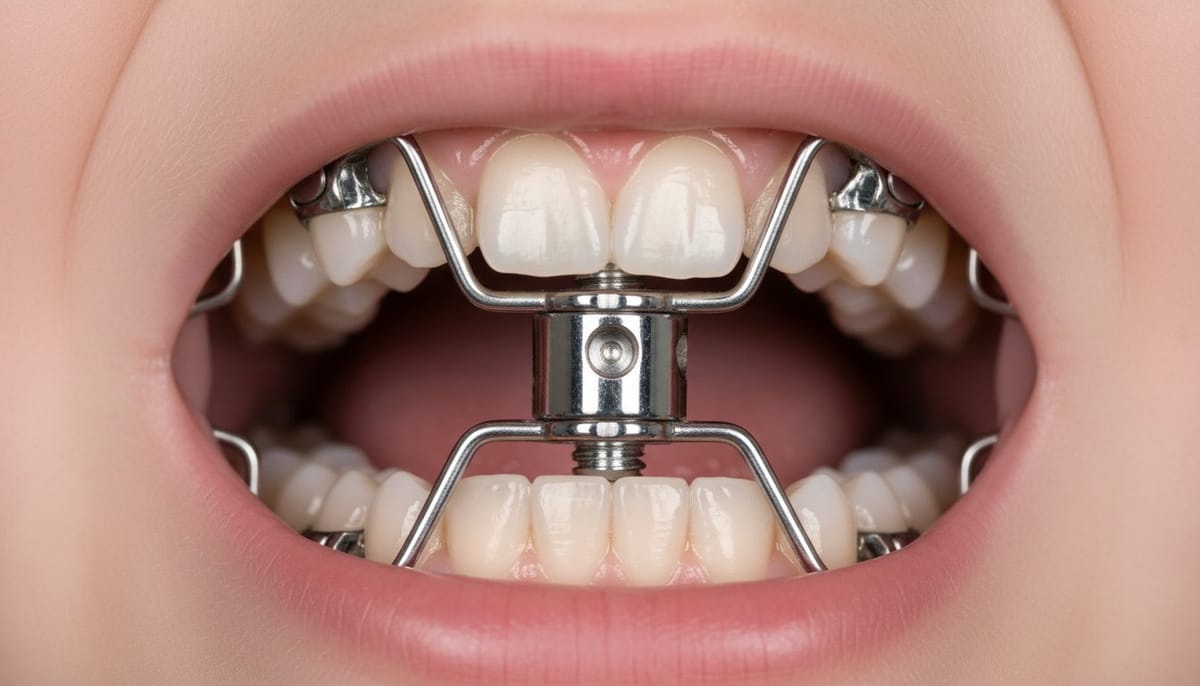
The palatal expander (or rapid palatal expander) is an appliance fixed to the upper molars. In the center, a screw allows activation of the expansion. The appliance is:
- Fixed: It stays in place 24/7
- Painless: Slight pressure is normal
- Temporary: Worn for approximately 6-12 months
How Does Treatment Proceed?
Phase 1: Active Expansion (2-4 weeks)
Parents turn the screw once or twice daily according to our instructions. Each turn widens the palate by approximately 0.25 mm. In total, an expansion of 5-8 mm is typically achieved.
Phase 2: Stabilization (4-6 months)
The appliance remains in place without activation to allow the bone to consolidate in its new position.
Phase 3: Removal and Follow-up
Once consolidation is complete, the appliance is removed. Additional orthodontic treatment may follow if necessary.
What Age to Intervene?
The ideal age for palatal expansion is generally between 7 and 12 years, before complete fusion of the palatal suture. After puberty, expansion becomes more complex and may require surgical assistance.
What to Expect
The First Days
- Pressure sensation during activation
- Slight difficulty speaking (temporary)
- Increased salivation
- Adjustment to chewing
During Treatment
- A gap may appear between the central incisors – this is normal and positive!
- This gap closes naturally or will be corrected afterwards
- Children adapt quickly to the appliance
The Results
Palatal expansion offers remarkable results:
- Creation of space for permanent teeth
- Correction of crossbite
- Improved nasal breathing
- Wider, more harmonious smile
- Potential reduction in future extraction needs
Conclusion
Palatal expansion perfectly illustrates the philosophy of interceptive orthodontics: treat early to prevent more significant problems later. If your child has a narrow palate, crossbite, or breathing problems, an early consultation can make all the difference.
Free consultation available at the Orthodontic Center of Dr. David Benguira to assess your child's needs.